

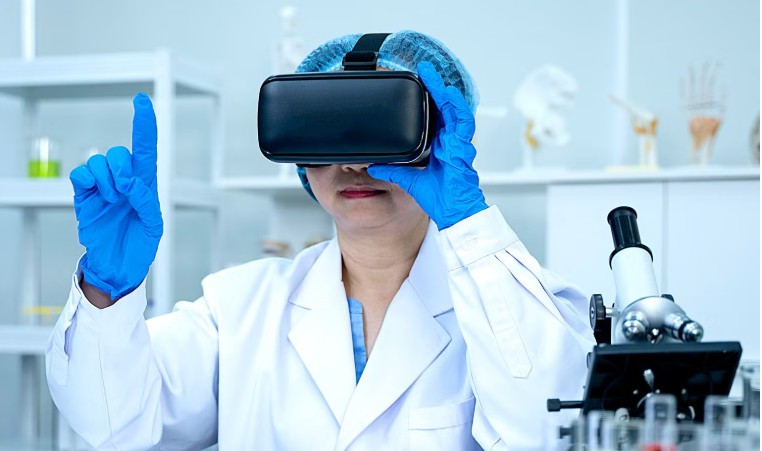


The rapid advancement of digital technologies has significantly transformed biomedical education and training. Among these innovations, virtual reality (VR) has emerged as a powerful tool for enhancing the understanding of complex biomedical systems. Digital biomedical learning integrates computational tools, simulation environments, and immersive technologies to provide students and professionals with interactive and practical learning experiences. In particular, VR enables users to explore the internal structure and functionality of biomedical devices in a highly detailed and controlled environment.
Virtual reality offers a three-dimensional, immersive environment where users can interact with digital models of biomedical devices. Unlike traditional learning methods, which rely heavily on textbooks and static images, VR allows learners to visualize intricate components and their relationships dynamically. This is especially important in biomedical engineering, where devices such as MRI scanners, prosthetics, and implantable systems have complex internal architectures.
Through VR simulations, learners can disassemble and reassemble devices virtually, observe their functioning in real time, and understand the interaction between mechanical, electrical, and biological components. This hands-on experience enhances spatial awareness and conceptual understanding, which are often difficult to achieve through conventional teaching approaches.
Virtual reality is increasingly used in training for biomedical device operation and maintenance. For example, medical students and engineers can simulate the use of surgical instruments, diagnostic devices, and life-support systems without the risks associated with real-world practice. This reduces costs, enhances safety, and allows repeated practice in a controlled setting.
Furthermore, VR can be used to simulate rare or complex scenarios that are difficult to replicate in real life. This is particularly beneficial in preparing professionals for emergency situations or specialized procedures. In industrial contexts, VR supports the design, testing, and optimization of biomedical devices before physical prototypes are developed.
Digital biomedical learning through virtual reality represents a significant advancement in the field of biomedical education. By providing immersive, interactive, and scientifically grounded learning environments, VR enhances the understanding of biomedical device structures and functions. As technology continues to evolve, the integration of VR in biomedical training is expected to expand, contributing to more effective education and improved healthcare outcomes.
Mekan TOYJANOV,
Head of the Nano and Biomedical Electronics
Department of the Oguzhan Engineering and Technology
University of Turkmenistan
Ogulnabat TAJIBAYEVA,
student of Oguzhan Engineering and Technology
University of Turkmenistan


Comments